
The Shahdara Bar Association has pledged its support to a woman advocate who was brutally assaulted by her husband. The Supreme Court has taken cognisance of the matter and issued directions to the Delhi Police.
The Supreme Court has directed the Delhi police commissioner to ensure the appearance of lawyer Mukut Nath Verma, who is accused of making defamatory allegations against Supreme Court judges and members of the SCBA election committee. The court has previously issued bailable warrants against Verma, but police have been unable to locate him.

Justice Surya Kant, on his first day as Chief Justice of India, established a new procedural norm requiring written requests for urgent case listings, with oral requests reserved for extraordinary circumstances. He also addressed various cases, including those related to extrajudicial killings and the removal of a lawyer from a government post.
The Supreme Court of India has issued a series of directives aimed at safeguarding lawyer-client privilege, restricting the ability of investigative agencies to arbitrarily summon lawyers for providing advice. The court's decision came in response to concerns about the Enforcement Directorate summoning lawyers in money laundering probes.

A lawyer allegedly attempted to throw a shoe at Chief Justice of India BR Gavai during court proceedings. Security intervened, and the lawyer was removed from the premises. The CJI remained composed and continued with the proceedings.
The Supreme Court has restrained lower courts from releasing the accused in a digital arrest fraud case where a 72-year-old lawyer was duped of Rs 3.29 crore. The court expressed concern over the growing cybercrime and the targeting of elderly citizens.

The Supreme Court of India strongly condemned the terrorist attack in Pahalgam, Kashmir, that killed at least 26 people, mostly tourists. The court observed a moment of silence in tribute to the victims and expressed condolences to their families. The attack was described as an affront to the values of humanity and the sanctity of life. The Supreme Court Bar Association and other legal bodies also condemned the attack and expressed solidarity with the victims and their families.
The Supreme Court has initiated a suo motu case regarding investigation agencies summoning lawyers and will examine if they can be put to notice. The action follows the Enforcement Directorate summoning senior lawyers, which was condemned by bar associations.

'In a courtroom, the judge can directly assess the witness's demeanour, which is crucial'
The Supreme Court addressed the issue of probe agencies summoning lawyers for providing legal advice to clients under investigation, emphasising that lawyers should not be summoned merely for offering legal advice but can be if they are assisting in the crime. The court is considering guidelines to prevent investigative overreach and protect lawyer-client privilege.

'In no way can an advocate be considered responsible for his or her client's actions.'

The Enforcement Directorate on Friday withdrew its summons to a senior lawyer for reportedly giving legal advice in a case after the Supreme Court Advocates on Record Association (SCAORA) wrote to the chief justice of India for taking note of the action.
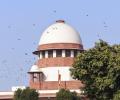
The Supreme Court asked its registry officials on Wednesday to comply with a recent order of the court in which it was directed that the practice of mentioning the caste or religion of litigants must be shunned.

Several Supreme Court lawyers on Monday wrote to the apex court alleging that they have received calls threatening judges over the case involving the security breach that left Prime Minister Narendra Modi stuck for 20 minutes on a flyover in Punjab last week.
The Supreme Court on Monday said it will organise its first 'hackathon' event to identify innovative ideas and explore practical propositions for refining and bringing in efficiency in the existing process from 'filing to listing' of judicial matters.

'It is a very vital issue and we cannot keep it pending. We intend to pass an order as to who will hear the matter.'
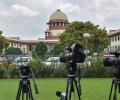
Observing that issues pertaining to the change of land use should be addressed on the administrative side, the Supreme Court on Thursday rejected the Supreme Court Bar Association's plea to allot an entire tract of land, which was allotted to the apex court, for conversion into a chamber block for lawyers.
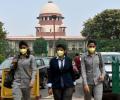
In a circular issued late Sunday evening, the top court cancelled the scheduled hearing in courts 2, 8 and 14 and said that from Wednesday only one bench of two judges will take up for hearing in only urgent matters through video conference.
'It is notified for the information of all concerned that considering the medical advice, as a precautionary measure to contain spread of Coronavirus (COVID-19) infection under the prevailing conditions, the Competent Authority has been pleased to direct that the advocates may wear 'plain white-shirt/white-salwar-kameez/white saree, with a plain-white neck band' during the hearings before the Supreme Court of India through Virtual Court System till medical exigencies exist or until further orders,' said the notification, issued by apex court Secretary General, Sanjeev S Kalgaonkar.

Government on Monday brought into force a controversial law to appoint members to the higher judiciary, two days before a Constitution Bench of the Supreme Court hears a clutch of petitions challenging the National Judicial Appointments Commission Act.

No process can offer a panacea for ethnic conflict, but there are times at which a legal process could work to defuse violence, asserts Supreme Court lawyer Devvrat.

A three-judge Supreme Court bench will hear petitions challenging the constitutional validity of the Waqf (Amendment) Act, 2025, on April 16. The petitions, including those by politicians and the All India Muslim Personal Law Board (AIMPLB) and Jamiat Ulama-i-Hind, were filed in the top court challenging the validity of the newly-enacted law. The Centre has filed a caveat in the apex court, seeking a hearing before any order is passed.

Away from the courtroom and legal circles, Nariman was a familiar figure for residents of Hauz Khas who would see him walk regularly, even in the cold winter months of December and January.
The Supreme Court of India will likely hear a batch of petitions challenging the constitutional validity of the Waqf (Amendment) Act, 2025 on April 15. The Act, which came into force on April 8, has been met with widespread criticism from various stakeholders, including politicians, the All India Muslim Personal Law Board (AIMPLB), and Jamiat Ulama-i-Hind. They argue that the law is discriminatory and violates the fundamental rights guaranteed under Articles 25 and 26 of the Constitution. The petitions allege that the amendments give the government more control over the administration of Waqf, effectively sidelining the Muslim minority from managing their own religious endowments.
The Supreme Court will on Monday resume hearing arguments on the constitutional validity of the National Judicial Appointment Commission Act, notwithstanding the ongoing summer vacation.

Highlighting the pendency of cases in various courts of the country, he said Indian legal system is marked by long delays and some of the reasons for it are infrastructure gaps and considerable vacancies, particularly in subordinate courts.
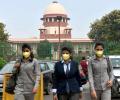
Three among the bigger courtrooms will be readied within that time for physical hearing, while adhering to the prescribed distancing and other norms and as per medical advice.
The Supreme Court will hear on Monday a batch of petitions challenging the 121st constitutional amendment by which collegium system for appointment of judges in higher judiciary was scrapped and a new mechanism under National Judicial Appointment Commission was proposed to be put in place.
The Supreme Court on Tuesday refused to accept Centre's preliminary plea that petitions challenging the new law on appointment of judges in higher judiciary.
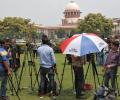
An apex court bench of Chief Justice Dipak Misra and Justices A M Khanwilkar and D Y Chandrachud said it will soon make the necessary rules for balancing rights of public and protecting dignity of litigants.
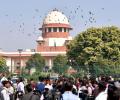
The apex court has been holding hearings through video conferencing since March 25 due to the COVID-19-induced nationwide lockdown and even after the restrictions were relaxed; it has decided to continue with the practice.

"The need is to strengthen the judiciary as a consequence of which the justice delivery system becomes fast, qualitatively responsive and serve the purpose of justice," he said.

Chief Justice of India-designate Justice U U Lalit on Friday highlighted three areas on which he intends to work during his 74-day tenure as the head of the judiciary and said he would strive hard to ensure that at least one Constitution bench is functioning in the Supreme Court throughout the year.
The SC on Wednesday restrained all high courts from entertaining any petition challenging validity of NJAC act meant to replace the two-decade-old collegium system.

'Is the idea of a committed judiciary once again being floated, though surreptitiously, unlike in the past when it was direct?'

Two pleas were filed in the Supreme Court on Wednesday over the tractor rally violence on Republic Day, with one seeking the setting up of a commission, headed by a retired apex court judge, to inquire into the incident, while the other urged it to direct the media not to declare farmers as "terrorist" without any evidence.

From almost 60 per cent as of December 2019, the share of liquidations in the mode of closure of total Insolvency and Bankruptcy Code (IBC) cases came down to 44 per cent till September 2023, data by the Insolvency and Bankruptcy Board of India (IBBI) shows. Experts say the decreasing trend in liquidations under the IBC in India can be largely attributed to the initial economic conditions of companies entering the Corporate Insolvency Resolution Process (CIRP). IBC experts also say the trend shows a certain stabilisation in IBC with the Code now rid of legacy bankruptcy issues.
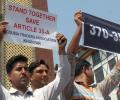
Several petitions challenging the Centre's decision to abrogate the provisions of Article 370 and the Jammu and Kashmir Reorganisation Act, 2019, which split J-K into two Union Territories Jammu and Kashmir, and Ladakh were referred to a constitution bench in 2019.
The Supreme Court on Tuesday tersely told the Centre that appointment of judges in higher judiciary is a "serious" business and cannot be left either to the "hit-and-trial" method or to the mercy of God.
Following objection from petitioners who claimed conflict of interest.
 © 2026 Rediff.com - Advertise with us - Disclaimer - Privacy Policy - Sitemap - Feedback - About us - Terms of use - Grievances